Turkish Breakfast Etiquette for a Shared Table
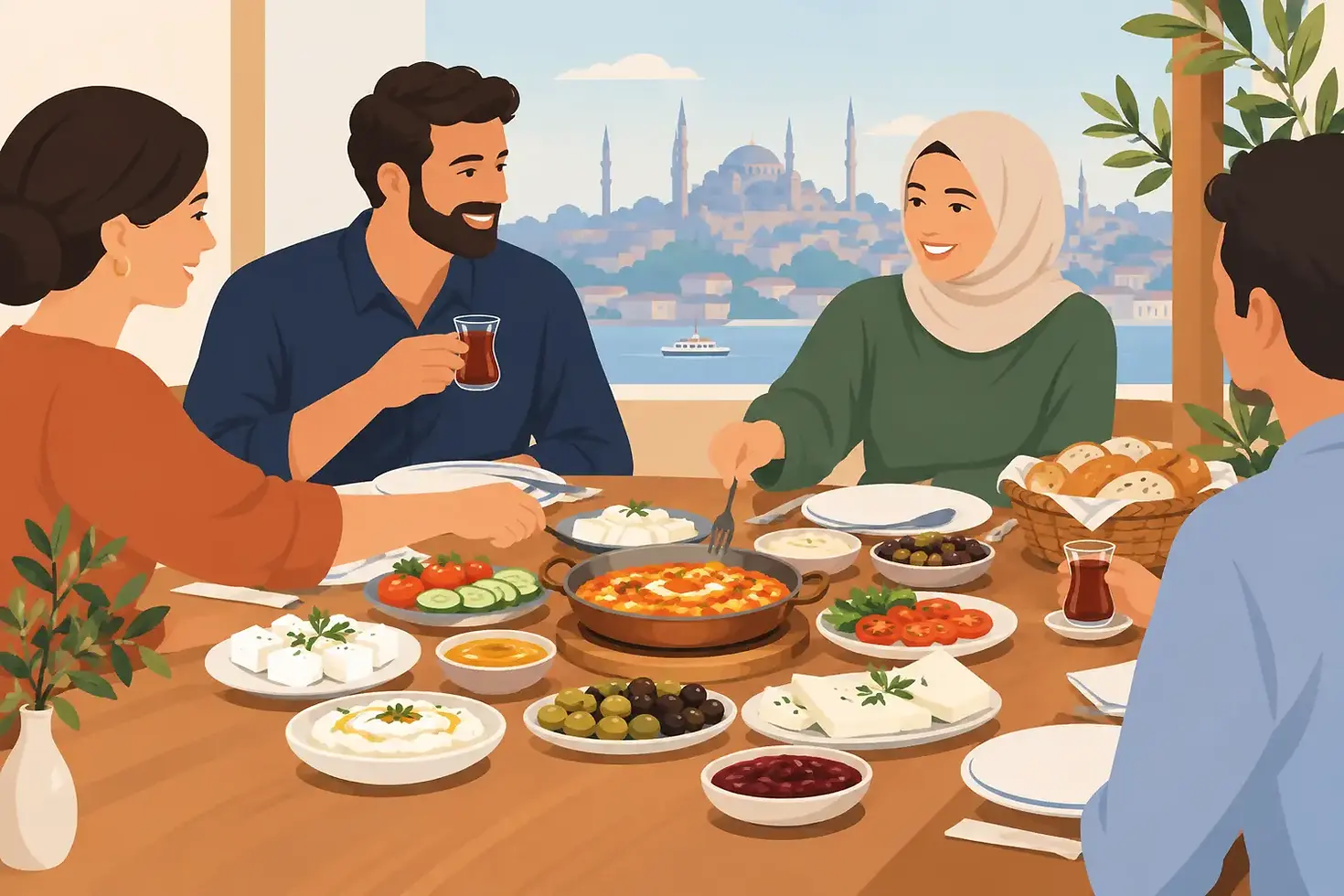
The first thing you notice at a Turkish breakfast table is that there is rarely one plate, one person, and one correct place to begin. There may be bowls of glossy black olives, slices of white cheese, honey pooling over clotted cream, warm bread, tomatoes, jam, eggs, and a tulip-shaped glass of tea that is never quite empty for long. Turkish breakfast etiquette begins with understanding this simple truth: breakfast is shared, and the pleasure is in taking your time together.
For travelers and newcomers, the abundance can feel wonderfully unfamiliar. Do you pass the bread? Should you pour the tea? Is it polite to finish the last piece of simit? The customs are less rigid than formal dining rules, but they carry a generous logic shaped by home kitchens, long conversations, and the belief that a table should make everyone feel cared for.
Turkish Breakfast Etiquette Starts With Sharing
A traditional Turkish breakfast, or kahvaltı, is not designed as a single composed dish. Its name comes from kahve altı, meaning "before coffee," a reminder that breakfast came before the day’s later cup of Turkish coffee. At the table, foods arrive in small shared plates: cheese, olives, preserves, butter, cucumbers, tomatoes, eggs, pastries, and breads. Regional tables may include spicy menemen, fried dough, village cheese, tahini and molasses, or seasonal fruit.
The gracious approach is to treat every dish as communal. Take modest portions at first, especially when the table is full or you are dining with people you have just met. You can always return for more. This is not about restraint for its own sake. It leaves room for everyone to taste what has been prepared and signals that the table belongs to the group, not to the fastest hand.
Bread often becomes the quiet center of the meal. Tear off a piece rather than reaching across the table with a whole loaf, then use it to enjoy cheese, jam, or eggs. In casual settings, it is perfectly natural to use bread to gather the last delicious bite of menemen. A fork is still welcome when it makes things easier. Turkish hospitality values comfort more than performance.
Let the table set the pace
There is no need to eat every item in a certain order. Some guests begin with savory cheese and olives, then move toward honey and kaymak, the thick clotted cream that turns a simple piece of bread into a celebration. Others make a small sandwich with fresh bread, cheese, and tomato before reaching for something sweet.
Follow the rhythm of your companions. If dishes are still arriving, do not assume the first plate is the entire breakfast. If someone offers you a specialty with particular enthusiasm, accept a small taste if you can. Food offered with pride is often a story in disguise: a family habit, a regional memory, a recipe that belongs to a grandmother’s kitchen.
The Gentle Ritual of Turkish Tea
Tea, or çay, is the pulse of breakfast. It is usually served strong in a narrow, clear glass that lets you see its deep amber color. The glass may be hot, so hold it by the rim or its small waist rather than wrapping your whole hand around it.
Sugar is a personal choice. Some people take it plain, others use one or two cubes. There is no rule requiring you to sweeten it, and there is no need to apologize for your preference. Milk is not a customary addition to Turkish tea, however, so if you want to experience the table as it is traditionally served, enjoy it clear.
Refills are part of the welcome. If a host notices your glass is low, they may offer more before you ask. A warm "thank you" is enough. If you have had enough tea, a polite "No, thank you" with a friendly gesture is completely acceptable. Refusing another glass does not reject the hospitality behind it.
At a restaurant, service may be attentive but less personal than at a family home. Even so, the same spirit remains: tea is an invitation to stay present. Breakfast is rarely rushed because the tea gives people a reason to linger another few minutes.
What to Do With the Last Bite
The last piece of bread, the final olive, or the last spoonful of jam can cause more hesitation than it deserves. In a close family setting, someone may insist that you take it. Among friends, there may be a brief, cheerful negotiation. The easiest rule is to offer it once before taking it yourself.
A simple "Would anyone like the last one?" is gracious and easy to understand in any setting. If no one does, enjoy it. Leaving food behind solely to appear polite is not necessary, particularly when it is clearly a beloved dish. Appreciation is often best shown by eating well and saying so.
There is one useful distinction: avoid taking the final portion directly from a shared dish while others are still actively eating unless you have offered it around. At a Turkish breakfast, abundance is part of the feeling, but consideration keeps that abundance generous.
Conversation Is Part of the Meal
In many cultures, breakfast is functional. In Turkey, especially on a slow weekend morning, it can be an occasion. The table invites conversation about the day ahead, family news, neighborhood observations, travel plans, and the food itself. Complimenting something you enjoy is never out of place.
If you are dining with Turkish friends or hosts, do not feel pressure to fill every silence or to speak formally. Curiosity is more meaningful than perfection. Ask what a cheese is called, whether a jam is homemade, or how they like their eggs. You may find that a small question opens a much larger conversation.
Phones are not forbidden, especially in a beautiful café where the table deserves a photograph. But take the photo without turning the entire meal into a production. The most respectful choice is to capture the color and care of the spread, then return to the people and plates in front of you.
Turkish Breakfast Etiquette at a Café
A café breakfast in Istanbul may be served as an individual platter, a set breakfast for two, or a larger spread meant for sharing. Read the menu’s cues, but do not overthink them. If a breakfast is described for two people, it is generally intended for the center of the table, even when the individual dishes arrive on separate plates.
At Dafne Cafe & Kitchen in Cihangir, as in many places where Turkish breakfast is prepared with care, the most fitting etiquette is appreciation without hurry. Let warm bread arrive warm. Share the dishes that catch everyone’s attention. Ask for more tea when you want it, and give the meal enough time to become more than a stop between plans.
If you have dietary needs, communicate them clearly and early. Turkish breakfast offers plenty of vegetarian choices, but dishes can include dairy, eggs, sesame, nuts, or meat products depending on the spread. Asking is not impolite. It helps the kitchen guide you toward the best experience.
A note on paying and inviting
When breakfast is shared among friends, the bill can be handled in many ways. One person may offer to treat the table, especially if they issued the invitation. Others may divide it evenly. There is no universal rule, so a brief conversation is better than a quiet assumption.
If a Turkish host firmly insists on paying, accepting with sincere thanks is often the warmest response. You can offer once or twice, but turning generosity into a prolonged argument can make an easy moment awkward. Save your kindness for the next tea, dessert, or invitation.
Come Hungry, Leave Unhurried
The beauty of a Turkish breakfast is not that it asks you to memorize rules. It asks you to notice what makes a shared meal feel generous: take enough, leave enough, offer the last bite, accept tea with gratitude, and make room for conversation.
When the plates are nearly empty and the tea has cooled to its final amber sip, there is no need to rush away from the table. Stay a little longer if you can. In that unhurried moment, breakfast becomes what it has always been meant to be: a small, daily celebration of being together.
Yorumlar