
Istanbul Food Culture Experience, Up Close
A simit still warm from the tray, tea poured into a tulip glass, the low hum of conversation before the day fully begins - this is where an istanbul food culture experience often starts. Not with spectacle, but with rhythm. In this city, eating is rarely just about hunger. It is about habit, welcome, memory, and the quiet pleasure of being at a table long enough for another dish to arrive.
Istanbul feeds you in layers. There is the quick bite eaten standing up by the ferry docks, and there is the breakfast that stretches deep into the morning. There are dishes shaped by migration, palace kitchens, neighborhood trades, family recipes, and modern city life. What makes the experience so powerful is not simply variety, though Istanbul has plenty of that. It is the way each meal carries a sense of place.
What defines an Istanbul food culture experience
To understand food in Istanbul, it helps to let go of the idea that a city has one single taste. Istanbul is not built that way. It is layered between continents, shaped by empires, villages, ports, and apartment kitchens. The table reflects that complexity.
A proper Istanbul meal can feel generous even when it is simple. Bread arrives first, almost as a gesture of trust. Tea appears naturally. Small plates invite sharing before anyone has fully decided what they like best. This matters because Turkish dining culture is deeply relational. Food is not presented as a private event. It is offered, discussed, passed around, compared to someone’s mother’s version, and remembered through stories.
That is why the strongest meals in the city tend to feel personal. Technique matters, of course. So do freshness, balance, and presentation. But what people remember is often the feeling that the table had a soul. Her Tabakta Bir Hikaye, Her Lokmada Bir Kültürdür is not just a beautiful phrase. It captures something real about how food lives in Istanbul.
Breakfast is where the culture reveals itself
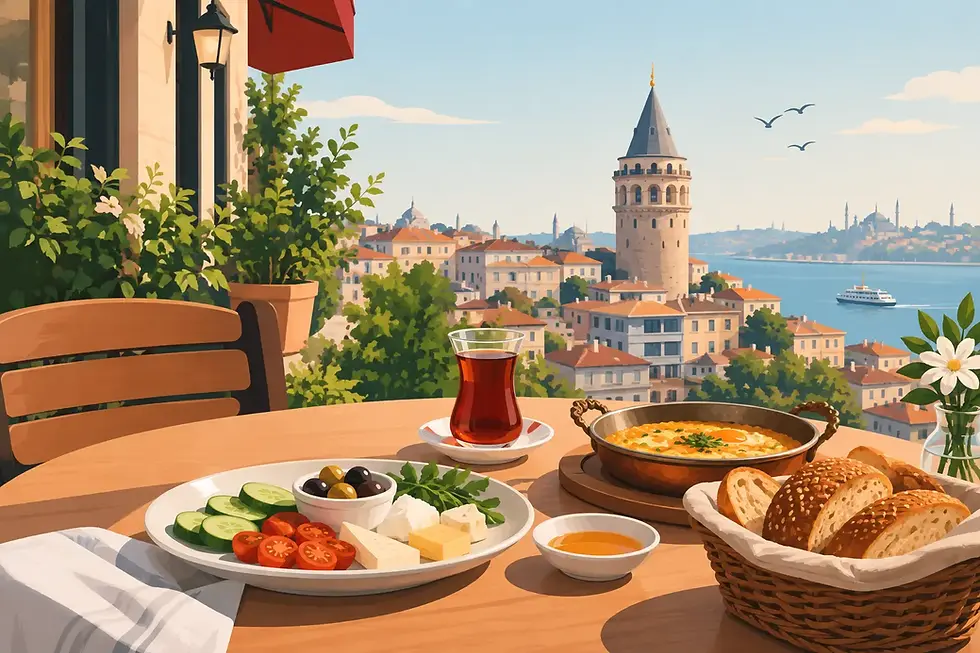
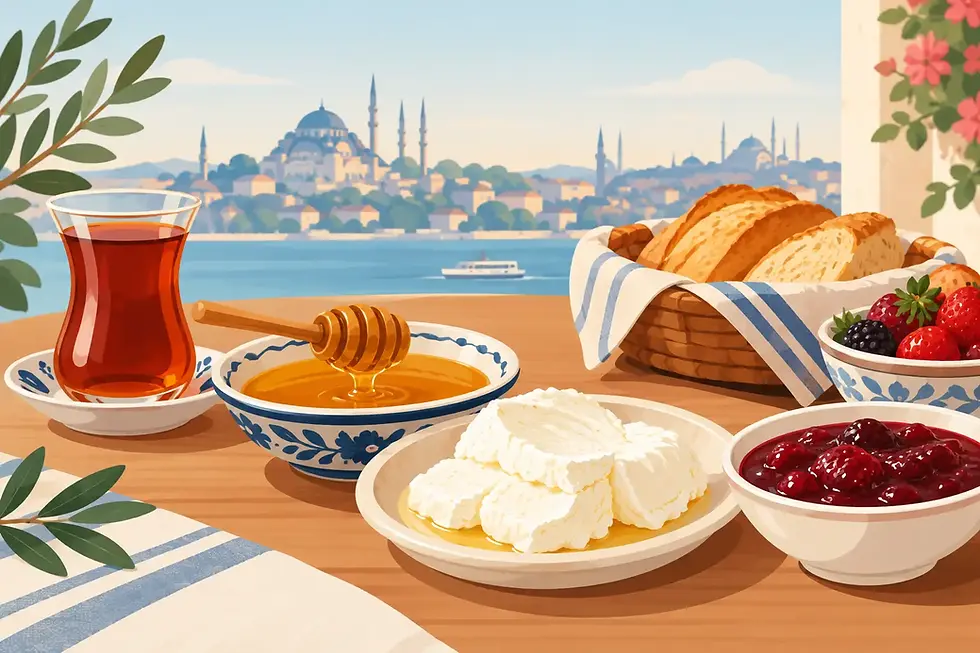
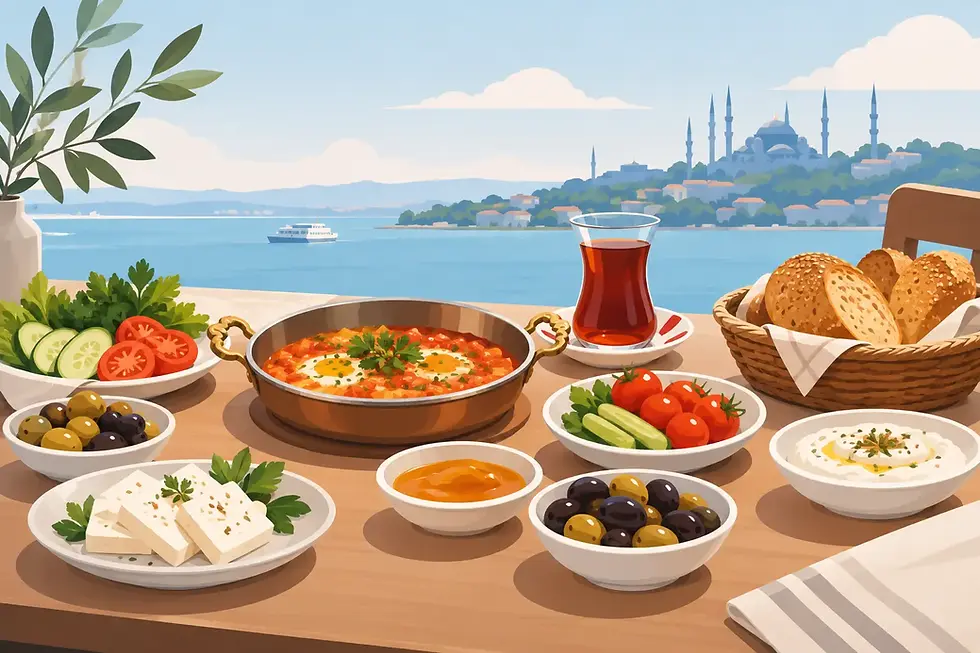
If one meal shows the emotional core of the city, it is breakfast. Turkish breakfast is not designed to be rushed. It asks you to stay. White cheese, olives, tomatoes, cucumbers, jams, honey, butter, eggs, fresh bread, perhaps börek, perhaps menemen, perhaps something regional that shifts the whole table in a new direction. A breakfast spread is both abundant and intimate.
For visitors from the US, this can be one of the first surprises. Breakfast in Istanbul is not built around a single plate. It is built around conversation and contrast. Salty and sweet sit side by side. Hot dishes and cold dishes share the table. Tea does not replace the meal. It extends it.
There is also a cultural truth hidden in this generosity. Breakfast reflects the Turkish idea that hospitality begins early. If someone is at your table, they should feel cared for. The details matter - the freshness of the bread, the brightness of the tomatoes, the quality of the cheese, the way eggs are cooked and served without fuss but with pride.
A memorable breakfast does not need to be theatrical. In fact, the more curated a table looks, the more important it becomes that the flavors remain honest. This is one of the trade-offs in modern Istanbul dining. A beautiful spread may catch the eye, but the places people return to are the ones where the food still feels rooted.
Street food tells the city at full speed
There is another side to the Istanbul food culture experience, and it lives in movement. On busy streets, near ferry crossings, beside markets, you see a different expression of the same food values: immediacy, familiarity, and pleasure without pretense.
Simit is one of the clearest examples. It is modest, portable, and woven into the city’s daily pattern. The same is true of roasted chestnuts in colder months, stuffed mussels for evening wanderers, kokoreç for those who like bold flavors, and fish sandwiches near the water. These foods belong to the public life of Istanbul. They are shaped by work schedules, weather, appetite, and neighborhood habits.
Street food also reminds you that authenticity is not always polished. Sometimes the most memorable bite comes wrapped in paper, eaten on a bench, with seagulls overhead and ferry horns in the background. Yet even here, standards matter. The best street foods are simple, but they are never careless. Texture, seasoning, freshness, and timing do the work.
For travelers, this is where instinct matters. A busy stall can be a good sign, but popularity alone is not a guarantee. Some places are beloved because they are convenient, others because they are truly excellent. The difference becomes clearer the more you eat.
The role of regional and Ottoman influences
One reason Istanbul’s food culture feels so rich is that the city gathers traditions from across Türkiye. You can taste the Black Sea, the Aegean, Central Anatolia, the Southeast, and old imperial influences without leaving the city. That range gives Istanbul a rare kind of culinary depth.
Anatolian cooking brings substance and regional character. You feel it in handmade mantı, slow-cooked stews, grain-based dishes, yogurt-based sauces, and recipes that favor patience over flash. These foods are often tied to home kitchens and inherited methods. They carry the warmth of repetition.
Ottoman-inspired dishes add another dimension. Here the meal becomes a conversation with history. Spices are often used with restraint rather than force. Fruit may appear in savory contexts. Rice, lamb, herbs, and sauces come together in ways that suggest refinement without losing comfort. The best versions do not feel like museum pieces. They feel alive.
That balance is important. Historical food can become stiff when treated only as heritage. Regional food can become heavy when it loses precision. The strongest kitchens understand both risks. They honor the source material while keeping the meal vivid and relevant to how people eat now.
Why atmosphere changes the taste
In Istanbul, setting matters more than many people expect. The same dish can land differently depending on the room, the pace of service, the music, the neighborhood, even the hour. A meal with Bosphorus views offers one kind of pleasure. A quiet table in a lived-in neighborhood cafe offers another.
This is why many culturally curious diners gravitate toward places where the atmosphere feels anchored rather than staged. In neighborhoods like Cihangir, the dining experience often carries a particular intimacy. You are close to the city’s movement, but not swallowed by it. Meals can unfold with more ease. You notice the tableware, the scent of butter or grilled bread, the cadence of nearby conversations.
At a place like Dafne Cafe & Kitchen, that atmosphere becomes part of the storytelling. The experience is not only about what is served, but how the meal holds together - heritage, comfort, presentation, and a sense of welcome that feels neither forced nor generic.
How to choose a meal that feels truly local
The best approach is not to chase the longest menu or the most viral plate. A better question is whether the restaurant seems to understand what each dish is trying to be. Does the breakfast feel composed with care or simply oversized? Does the mantı taste handmade in spirit, even if presented with modern polish? Do Ottoman references feel thoughtful or decorative?
A truly local meal often gives you a mix of familiarity and surprise. There may be a dish you recognize, but prepared with more nuance than you expected. There may be a flavor combination that feels new but somehow immediately comforting. And there is usually a sense that the food belongs not only to a chef, but to a broader cultural memory.
It also helps to order in a way that matches the city. Share. Let the table widen gradually. Start with a few things and respond to your appetite rather than trying to complete a checklist. Istanbul rewards curiosity, but it rewards presence even more.
The real memory is the feeling of the table
Ask people what they remember most from eating in Istanbul, and many will mention a specific detail: the sheen of olive oil over a meze, the softness of fresh bread, the sharp sweetness of tea after a savory bite, the comfort of a dish that tasted older than the room it was served in. But underneath those details is something larger.
The real memory is often the feeling that the meal welcomed you into a living culture. Not as a performance, and not as a quick transaction, but as a shared human ritual. That is what makes an Istanbul food culture experience stay with you. Long after the plates are cleared, you remember how generously the city set the table.
Yorumlar